The hall
The Baroque riding hall
The Winter Riding School in the Hofburg: when it was built and for whom, what it looks like, and what else has happened in the room besides horses.
Reserve a place for the training ↗A hall for a riding school
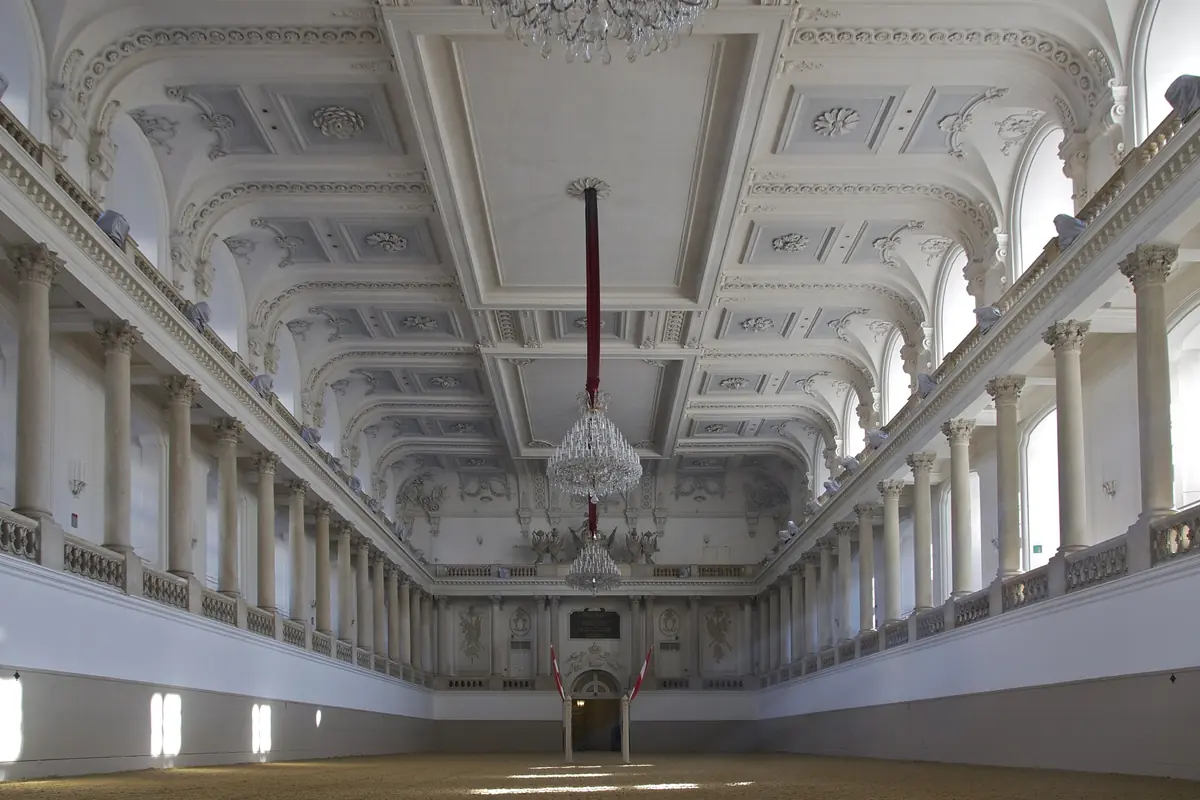
The hall used for the training is the Winter Riding School in the Hofburg, built between 1729 and 1735 under Emperor Charles VI. The riding school's history page names the Fischer von Erlach family of architects: Johann Bernhard drew the plans and his son Joseph Emanuel carried them out. English Wikipedia names the son as the architect, so both can be true at once. Before the hall, the riding school worked from a wooden arena on what is now Josefsplatz, and a riding place at that spot is first mentioned in 1565.
White, beige and light grey
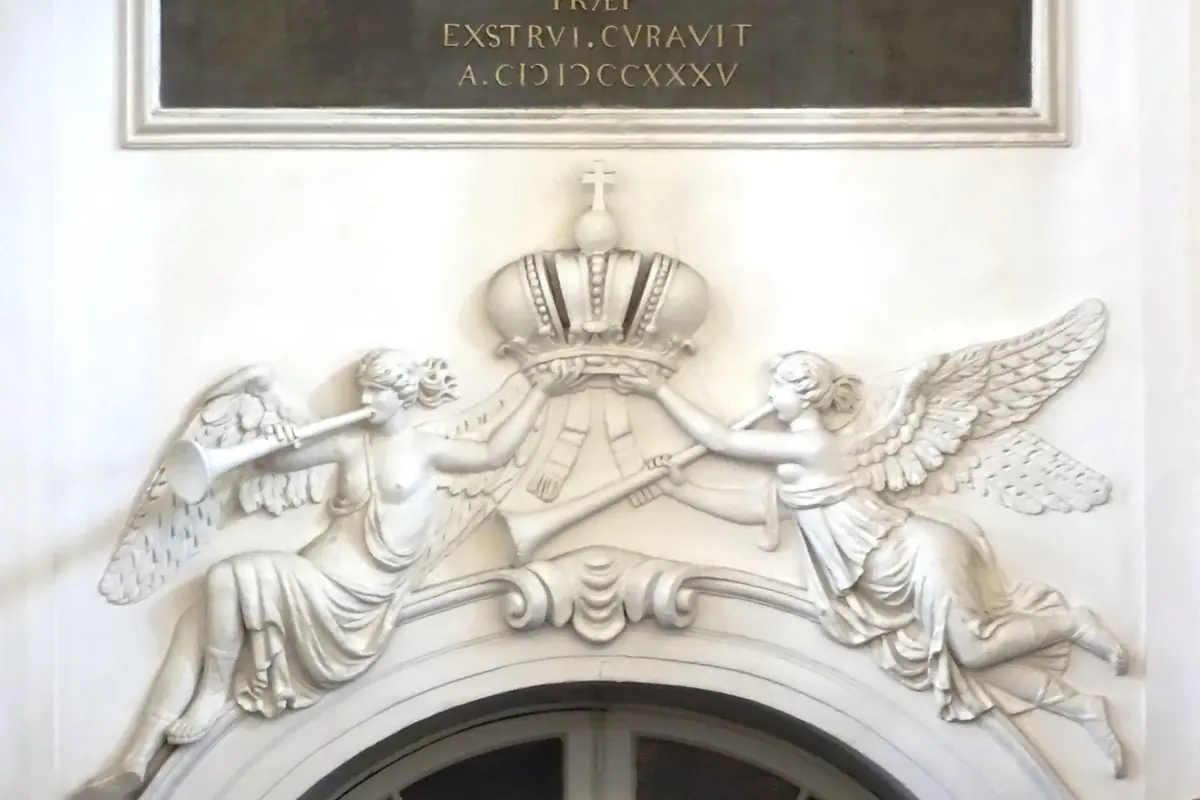
The hall is mostly white, with some beige and light grey, which suits the grey horses. Opposite the entrance, above the royal box, hangs a portrait of Emperor Charles VI, and the riders always salute it before they ride. The riding school describes the portrait as a sign of gratitude for the building. Stucco work around the doors and the cornice carries the Baroque decoration, and the relief above one of the doors shows two winged figures holding a crown. The overall effect is calm rather than ornate.
The size of it
Wikipedia gives the hall as 55 metres long and 18 metres wide, with a height of 17 metres. Seen from the gallery it looks even taller than that, because the columns and the gallery balustrades draw the eye up to the ceiling. The proportion, long and tall rather than square, is what gives the hall its sense of a nave. The sand floor fills the middle, and the galleries and boxes look down on it from the sides, so the horses are always seen from above or from the side.
Chandeliers and galleries
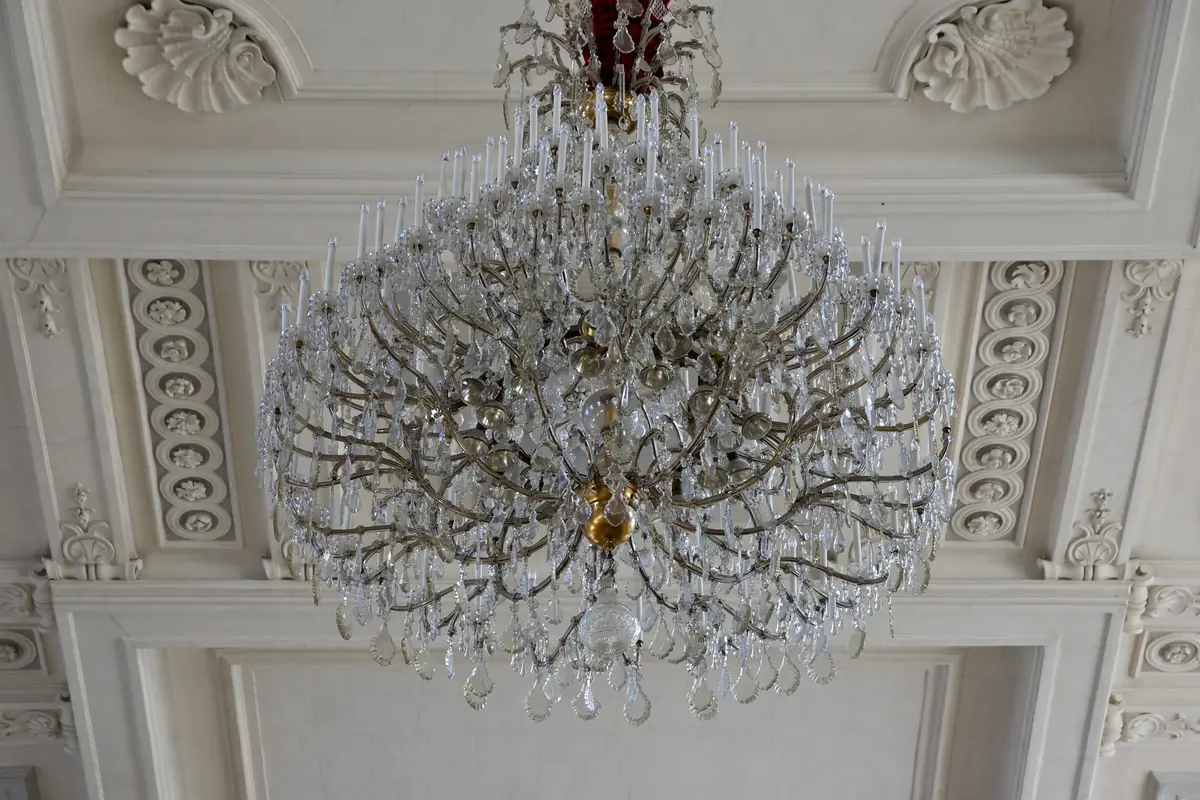
Chandeliers hang above the arena, and galleries run around the sides. The riding school lists a royal box, a ground-floor box beneath it, and a first and second gallery. There is no lift, and the royal box and both galleries are reached by stairs. That is worth knowing, because where you sit in a listed building like this is partly a matter of how you climb.
Not only horses
Under Empress Maria Theresia, who came to the throne in 1740, the hall hosted carousels, masquerades, equestrian games and court balls, according to the riding school's own history page. In 1848 the first parliament of the monarchy convened there, the same page says. The hall is used today for ceremonies and events as well as for the horses. Those other lives are part of why it is more than a stable with decoration: it has been a room in which the Habsburg court showed itself to the city.
Where the hall sits
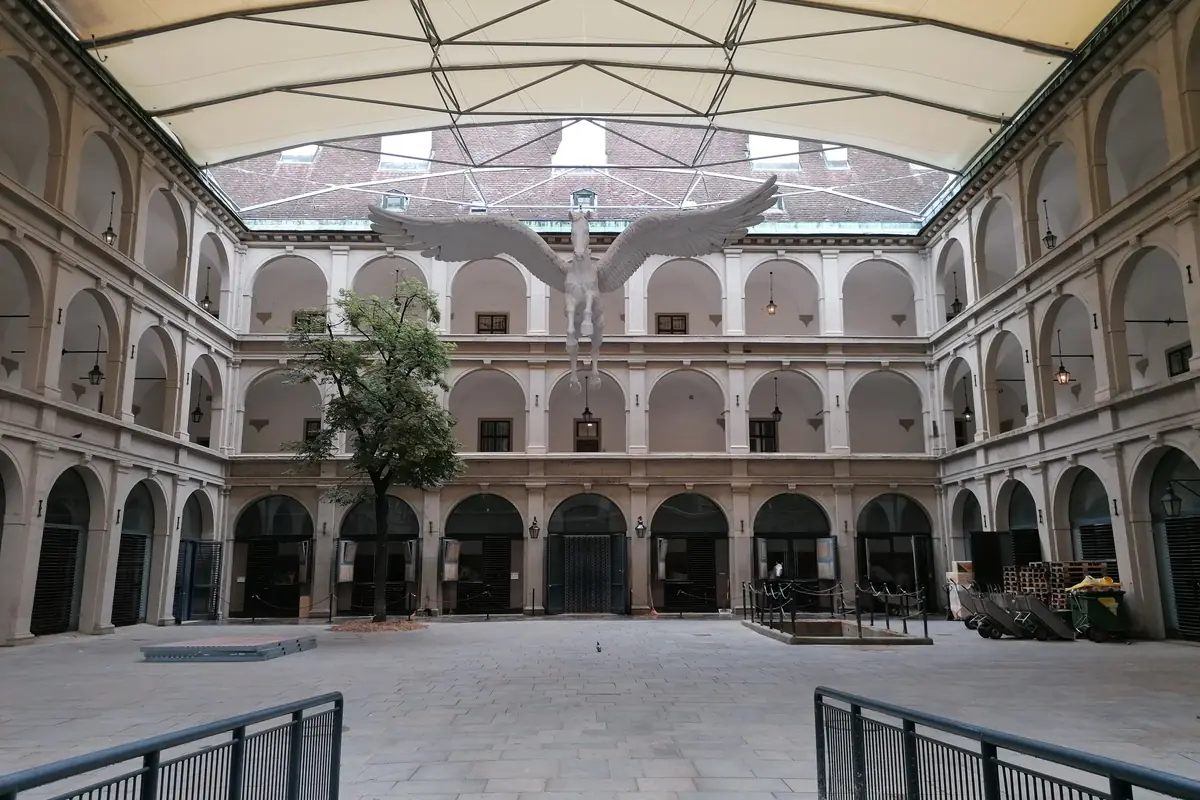
The hall stands in the Hofburg, between Josefsplatz and the square at the Hofburg's main gate. Next to it is the Stallburg, a Renaissance building from the 1560s that was once a residence and then housed the imperial stables, and which the riding school still uses for its stallions. The Stallburg also housed an art collection from 1659 to 1776 that later formed the core of the Kunsthistorisches Museum. A visit to the hall therefore sits inside a block of the Hofburg that rewards a slow walk around the outside.
A working room
The hall is first of all a workplace. The riding school's own pages say its riders train their stallions here, and the sand floor, the barrier and the two flags you see in photographs belong to that work. The riders' salute to the portrait of Charles VI is part of every ride. Seeing the hall in use is the point of a morning visit: it is not set up for you, you are let in to watch a room do what it was built for, and some visitors find that more affecting than the decoration. A guided tour shows you the rooms around it.
Sources